

BOTH Instrument & Industrial Equipment (Shanghai) Co., Ltd. is a professional manufacturer of vacuum freeze dryers, providing solutions from household and commercial freeze dryers to pilot-scale and industrial freeze drying systems. Since 2007, BOTH has focused on the R&D, manufacturing, OEM/ODM customization, and turnkey production line design of freeze drying equipment for food, nutrition, biopharmaceutical, herbal, and biological research applications.
For food producers, freeze drying is more than a preservation method. It is a high-value processing technology used to produce freeze-dried fruits, vegetables, meat, instant meals, probiotic powder, nutritional supplements, pet food, herbal powder, and other premium products. One of the biggest advantages of a food freeze dryer is its ability to preserve more than 95% of the original nutrition in many materials.
So, why can freeze drying equipment protect nutrients so effectively? The answer lies in low-temperature vacuum sublimation.
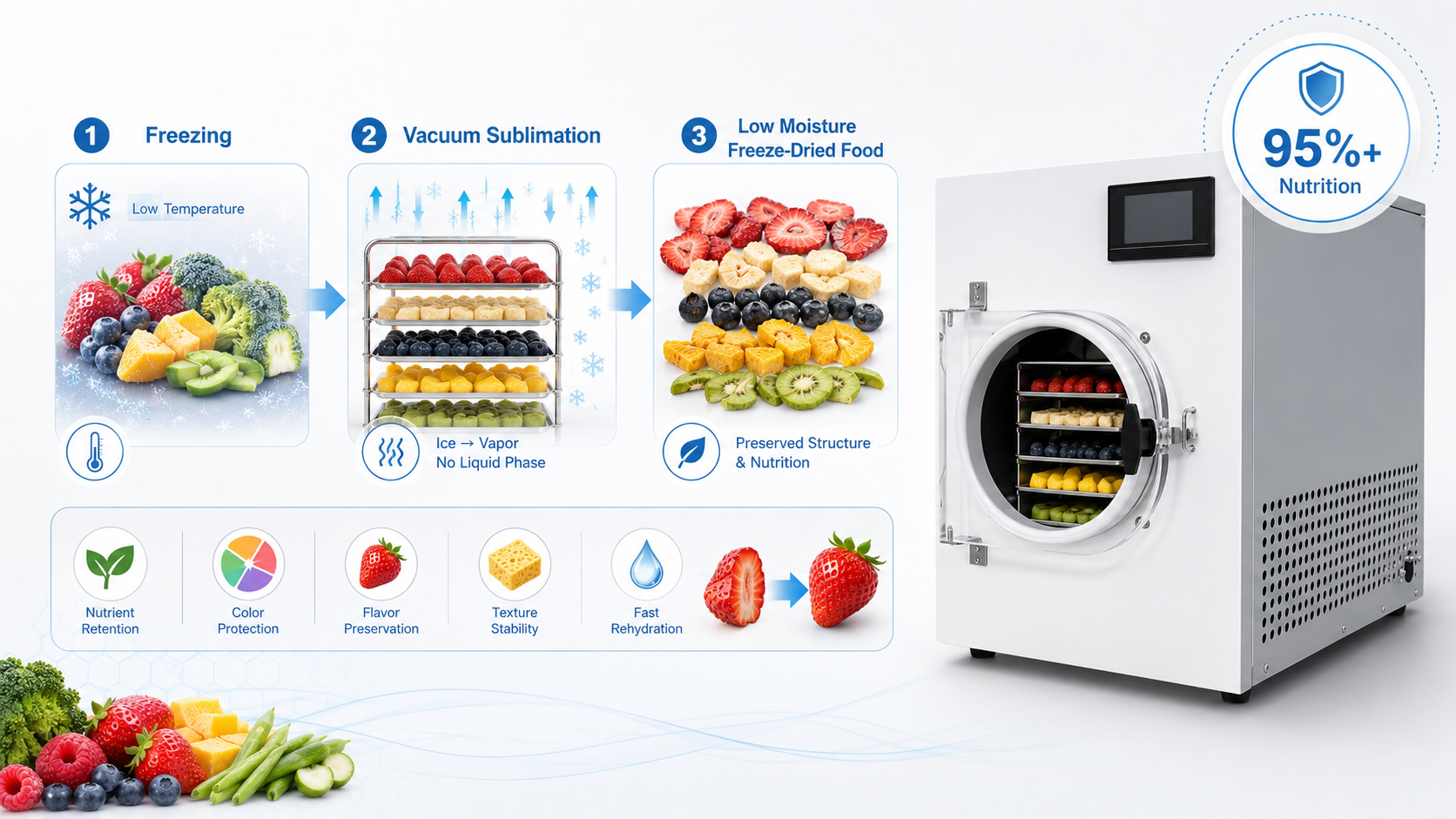
1. Food Freeze Dryers Avoid High-Temperature Nutrient Loss
Traditional drying methods such as hot-air drying, sun drying, baking, and roasting usually remove moisture by heating the food. During this process, water evaporates from the liquid phase. However, many nutrients in fruits and vegetables are sensitive to heat and oxygen.
For example, vitamin C is easily destroyed during high-temperature processing. In traditional hot-air drying, the vitamin C loss rate in fruits and vegetables may reach 30% to 50%. At temperatures around 100°C, vitamin B2 in carrots can also suffer serious degradation.
A food freeze dryer avoids this problem by using a completely different drying principle. Instead of heating the food until liquid water evaporates, a vacuum freeze dryer first freezes the material and then removes moisture through sublimation.
This low-temperature process helps reduce damage to vitamins, minerals, proteins, natural pigments, flavor compounds, and other active ingredients.
2. The Core Principle: Low-Temperature Vacuum Sublimation
The key technology behind a food freeze drying machine is sublimation drying.
In a typical freeze drying process, the food is first rapidly frozen to around -30°C to -60°C or below. The water inside the food turns into solid ice crystals. Then, under a high-vacuum environment, these ice crystals change directly from solid ice into water vapor, without passing through the liquid phase.
This process is called sublimation.
Because freeze drying takes place under low temperature and low pressure, it avoids the main causes of nutrient loss in traditional drying: high heat, oxidation, liquid water migration, and structural collapse.
After freeze drying, the final moisture content of the food can usually be reduced to below 5%. This helps inhibit microbial growth and supports long-term storage at room temperature.
3. Why Freeze-Dried Food Retains Better Nutrition
Food freeze dryers can preserve nutrients effectively for several reasons.
First, the low-temperature environment protects heat-sensitive nutrients such as vitamin C, vitamin B, natural enzymes, and certain antioxidants.
Second, the vacuum environment reduces oxygen exposure, which helps slow down oxidation of color, flavor, and active ingredients.
Third, because water is removed through sublimation instead of boiling or evaporation, the food structure is less damaged.
Finally, the drying process helps maintain the original biochemical properties of many materials, making freeze drying especially suitable for high-value foods and functional ingredients.
This is why freeze drying technology is widely used for fruits, vegetables, probiotics, nutrition powders, herbal ingredients, biopharmaceutical products, and other sensitive materials.
4. Better Color, Flavor, Texture, and Rehydration
The benefits of a freeze drying machine are not limited to nutrition retention. Freeze-dried food also performs well in appearance, taste, aroma, and rehydration.
Because there is no destructive high-temperature treatment, freeze-dried fruits and vegetables can maintain their natural color more effectively. The product is also less likely to shrink, darken, or harden on the surface.
During freeze drying, ice crystals leave behind a porous, sponge-like structure after sublimation. This structure allows water to enter the product quickly during rehydration. Many freeze-dried foods can rehydrate within 3 to 5 minutes and return close to their original fresh condition.
This is a major advantage over hot-air-dried products, which often have poor rehydration performance and a tougher texture.
Freeze drying also helps protect volatile aroma compounds. As a result, freeze-dried food often smells and tastes closer to fresh ingredients after opening.
5. Applications of Food Freeze Drying Technology
Food freeze drying technology is now widely used in many high-value industries.
Common applications include:
Freeze-dried fruits such as strawberries, mangoes, bananas, apples, blueberries, and durian.
Freeze-dried vegetables such as broccoli, carrots, corn, spinach, mushrooms, onions, and peppers.
Freeze-dried meat, seafood, instant meals, soup ingredients, and outdoor food.
Probiotic powder, enzyme powder, nutritional powder, protein ingredients, and health supplements.
Infant food, pet food, herbal powder, flower tea, coffee, and specialty agricultural products.
In addition, freeze drying is often used in emergency food, military food, and space food because it provides long shelf life, light weight, convenient transportation, and good nutritional stability.
For food factories and agricultural producers, freeze drying can turn seasonal raw materials into stable, high-value products with longer sales cycles and broader market potential.
6. Combined Processing Solutions: Freeze Drying and Molecular Distillation
Some projects require more than one processing technology.
For example, freeze drying is ideal for removing water from fruits, vegetables, probiotics, herbs, and nutritional materials while preserving structure and activity. Molecular distillation, on the other hand, is suitable for the purification, separation, and concentration of heat-sensitive oils and active ingredients.
A combined solution may be useful for:
Herbal active ingredient processing
Plant extract concentration and purification
Fish oil and Omega-3 processing
Vitamin E and tocopherol purification
MCT oil processing
Aroma and essential oil refinement
High-value nutrition and health product production
For customers developing both dry powders and purified oils or extracts, BOTH can provide integrated freeze drying and molecular distillation solutions from lab testing to pilot production and industrial scale-up.
7. How to Choose the Right Food Freeze Dryer
Choosing the right food freeze dryer depends on the material type, moisture content, batch size, final product form, production schedule, and future expansion plan.
For R&D and formula testing, a laboratory freeze dryer is usually suitable. It helps users test drying curves, appearance, taste, rehydration, and nutrient retention before investing in larger equipment.
For small food businesses, farms, stores, and start-up brands, a commercial freeze dryer can support small-batch production and product development.
For factories preparing for larger output, a pilot-scale freeze dryer helps bridge the gap between lab testing and industrial production.
For large-scale manufacturing, an industrial freeze dryer or complete freeze-dried production line is recommended. These systems are designed for higher capacity, stable process control, data traceability, and long-term operation.
A practical scale-up path is:
Lab freeze dryer → pilot freeze dryer → commercial freeze dryer → industrial freeze drying production line
This step-by-step approach helps reduce investment risk, improve product quality, and build a process that can grow with market demand.
8. Why Choose BOTH Freeze Drying Equipment?
BOTH provides a wide range of vacuum freeze dryers for different production needs, including household freeze dryers, commercial freeze dryers, laboratory freeze dryers, pilot-scale freeze dryers, production-scale freeze dryers, and customized freeze-dried production lines.
Our freeze drying equipment is widely used in food production, nutrition and health products, biopharmaceuticals, herbal processing, biological research, and other industries.
BOTH can support customers with material testing, equipment selection, process optimization, OEM/ODM customization, and turnkey production line design. Whether you are developing freeze-dried fruit snacks, vegetable powders, instant meals, probiotics, herbal products, pet food, or nutritional supplements, our engineering team can help you select the right solution.
Conclusion
Food freeze dryers can preserve more than 95% of food nutrition in many applications because they use low-temperature vacuum sublimation. This process removes water directly from ice to vapor, avoiding the liquid water phase and reducing the damage caused by high heat and oxidation.
Compared with traditional drying methods, freeze drying technology offers better nutrient retention, color protection, flavor preservation, texture stability, and rehydration performance. It is one of the most effective processing technologies for high-quality healthy food production.
For food brands, farms, laboratories, and factories, investing in the right freeze drying machine can help create higher-value products, extend shelf life, reduce waste, and expand market opportunities.
What is your current production scale? Are you planning to expand? What capacity do you need per batch or per day?
Talk to BOTH engineers today to get a customized freeze drying solution for your material, capacity, and production goal.
FAQ
1. What is a food freeze dryer?
A food freeze dryer is a machine that removes moisture from food by freezing the material and then drying it under vacuum. The water inside the food sublimates directly from ice into vapor, helping preserve nutrition, color, flavor, and structure.
2. Why does freeze drying preserve more nutrition than hot-air drying?
Freeze drying works at low temperature and under vacuum, so it avoids the high heat and oxidation that often damage vitamins, pigments, flavors, and active ingredients during traditional drying.
3. Can freeze-dried food retain more than 95% of its nutrition?
In many materials, freeze drying can retain more than 95% of key nutrients, especially when the process is properly designed according to the material’s freezing point, moisture content, thickness, and drying curve.
4. What foods can be processed by a freeze drying machine?
A freeze drying machine can process fruits, vegetables, meat, seafood, instant meals, probiotics, dairy products, nutritional powders, herbal materials, pet food, coffee, tea, and many other food ingredients.
5. What is the moisture content after freeze drying?
The final moisture content of freeze-dried food is usually below 5%, depending on the material and process requirements. Lower moisture helps improve shelf life and storage stability.
6. How long can freeze-dried food be stored?
With proper drying, packaging, and storage conditions, freeze-dried food can have a long shelf life at room temperature. The exact storage time depends on the product type, residual moisture, packaging material, oxygen level, and storage environment.
7. How do I choose a commercial freeze dryer?
You should consider your material type, batch capacity, tray area, moisture content, target drying time, final product form, and future expansion plan. For growing businesses, it is often better to choose equipment that supports scale-up from pilot testing to industrial production.
8. Does BOTH provide customized freeze drying solutions?
Yes. BOTH provides freeze dryer selection, material testing, process support, OEM/ODM customization, and turnkey freeze-dried production line solutions for food, nutrition, herbal, biopharmaceutical, and biological applications.
9. Can freeze drying be combined with molecular distillation?
Yes. Freeze drying is suitable for dehydration and powder production, while molecular distillation is suitable for purification and concentration of heat-sensitive oils, extracts, and active ingredients. Combining both technologies can support more complete processing solutions for herbal, nutrition, fish oil, vitamin, and functional product projects.
10. How can I get the right freeze dryer model?
You can contact BOTH engineers with your material name, current production scale, target capacity, moisture content, and expansion plan. Our team can recommend a suitable lab, pilot, commercial, or industrial freeze drying solution.
Post time: Jul-20-2026