

As consumer expectations for food quality and safety continue to rise, food processing technologies are also being continuously improved. Freeze drying technology helps manufacturers produce safer, more stable, and higher-quality food products while preserving nutrition, color, flavor, and structure.
A food freeze dryer applies low-temperature freezing and vacuum sublimation to remove moisture from food. However, freeze drying equipment represents a significant investment. Proper maintenance can extend the machine’s service life, reduce unexpected downtime, and lower long-term production costs.
So, how should a food freeze dryer be maintained effectively?
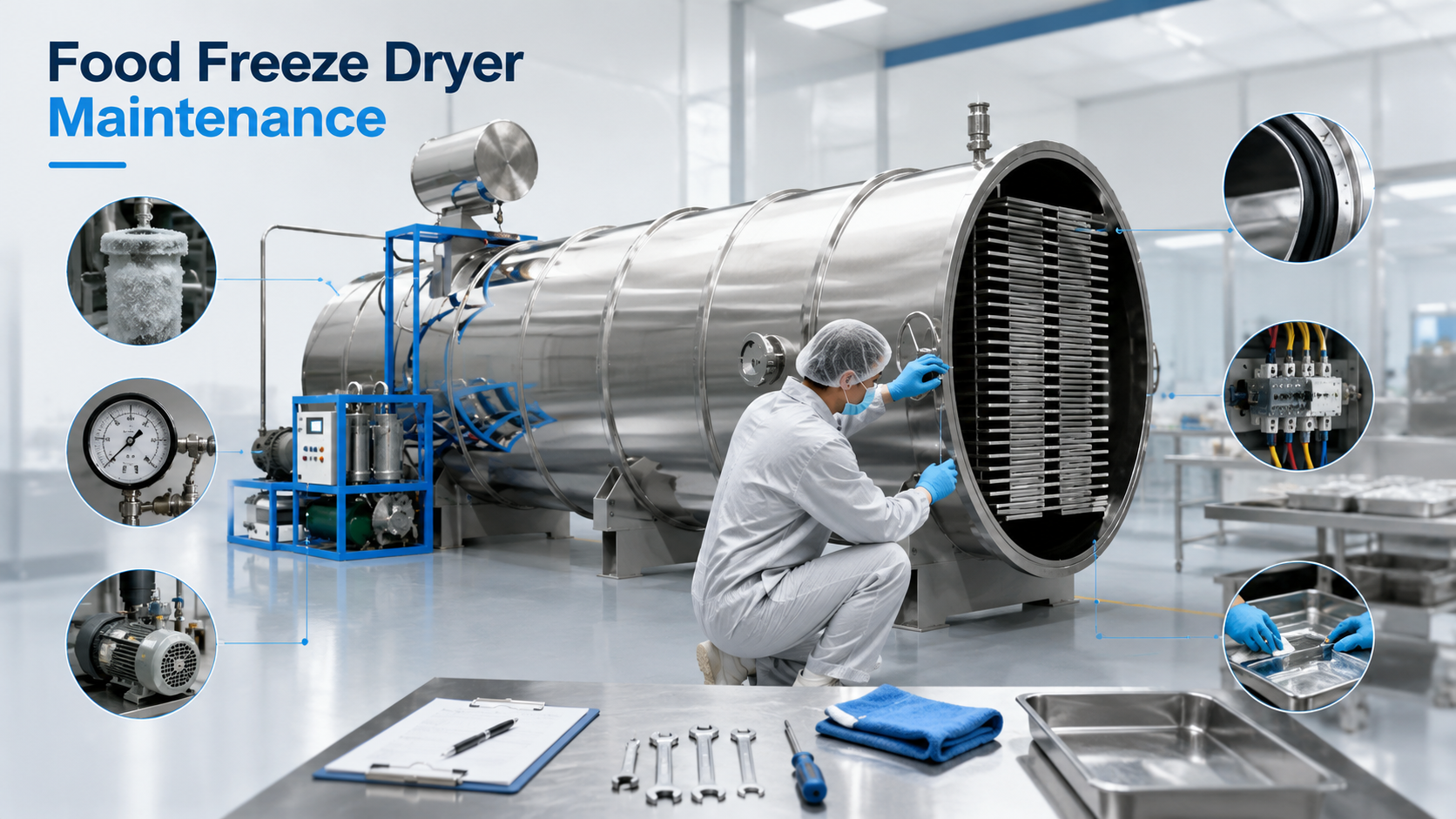
1. Regularly Clean the Exterior and Interior of the Equipment
During operation, moisture, product residues, dust, and other contaminants may accumulate on the machine, trays, drying chamber, cold trap, and related components.
The exterior and interior of the freeze dryer should therefore be cleaned regularly. Food-contact surfaces, including trays and the drying chamber, should be cleaned according to food hygiene requirements after each production batch.
Use a clean, soft cloth and suitable cleaning agents recommended by the equipment manufacturer. Avoid allowing excessive water to enter electrical components, control panels, vacuum connections, or other sensitive areas, as this may cause corrosion or electrical failure.
Before cleaning, the equipment should be switched off, disconnected from the power supply, and allowed to return to a safe temperature and pressure.
2. Regularly Clean and Replace Filters
Filters help prevent dust, oil mist, particles, and other contaminants from entering or leaving key parts of the system.
If a filter becomes blocked, airflow may be restricted and equipment efficiency may decrease. It can also increase the load on ventilation, refrigeration, or vacuum components.
Filters should be inspected and cleaned regularly. Damaged, heavily contaminated, or blocked filters should be replaced according to the manufacturer’s recommended maintenance schedule.
The exact filter type and replacement interval depend on the freeze dryer configuration, working environment, material characteristics, and operating frequency.
3. Inspect Electrical Cables and Power Connections
After extended use, electrical cables, plugs, terminals, and power cords may become worn, loose, or aged. These problems can affect equipment stability and create electrical safety risks.
Operators should regularly inspect:
- Power cables and plugs
- Electrical terminals and connectors
- Grounding connections
- Control cabinet wiring
- Emergency stop and protection devices
Any damaged cable or loose electrical connection should be repaired or replaced by qualified personnel. Electrical maintenance should not be performed while the machine is energized.
4. Maintain Good Vacuum Sealing Performance
Vacuum sealing performance is one of the most important factors affecting freeze drying efficiency.
If the drying chamber, door seal, pipeline connection, valve, or vacuum hose leaks, air may enter the system. This can make it difficult to reach the required vacuum level, extend the drying cycle, increase energy consumption, and reduce product quality.
The sealing door, silicone sealing ring, vacuum pipes, valves, and joints should be inspected regularly. Sealing surfaces should be kept clean and free from food residues, dust, oil, and physical damage.
Aging, cracked, deformed, or hardened sealing rings should be replaced promptly. Vacuum leak testing should also be included in routine maintenance, particularly for commercial and industrial freeze dryers.
5. Perform Regular Lubrication and Vacuum Pump Maintenance
Moving components and vacuum systems require regular inspection and maintenance.
For oil-sealed vacuum pumps, operators should regularly check the vacuum pump oil level, color, viscosity, and contamination condition. Pump oil should be replaced according to the operating hours and the manufacturer’s recommendations.
If the pump oil becomes cloudy, dark, emulsified, or contaminated with water, it may reduce pumping efficiency and affect the ultimate vacuum level.
Other moving or mechanical components should be lubricated only with suitable lubricants and according to the equipment manual. Excessive or incorrect lubrication may cause contamination or component damage.
Oil-free vacuum pumps also require periodic inspection, although their maintenance requirements differ from oil-sealed pumps.
6. Keep Foreign Objects Out of the Equipment
Foreign objects should never be allowed to enter the drying chamber, cold trap, vacuum pipeline, compressor ventilation area, or mechanical components.
Before loading the machine, check the raw material, trays, and chamber carefully. Packaging fragments, tools, metal parts, cloth fibers, and other objects may damage the equipment, block pipelines, contaminate food, or affect vacuum performance.
Operators should use dedicated tools and follow standard loading and unloading procedures. The machine should not be struck, modified, or opened during operation unless the operating procedure specifically permits it.
7. Defrost and Drain the Cold Trap Properly
During freeze drying, water vapor released from the food is captured as ice on the cold trap. After each cycle, the accumulated ice should be completely defrosted and drained.
Starting a new batch before the cold trap is fully defrosted may reduce ice capture capacity and vacuum stability. Residual water may also cause hygiene problems or affect the next drying cycle.
The cold trap should be cleaned and dried after defrosting. Operators should also check the drainage pipe and valve to make sure they are not blocked or leaking.
8. Record Maintenance and Operating Data
A maintenance record helps food factories identify abnormal equipment behavior before a serious failure occurs.
Important information may include:
- · Operating hours
- · Vacuum level
- · Cold trap temperature
- · Shelf temperature
- · Drying cycle duration
- · Vacuum pump oil replacement
- · Filter cleaning and replacement
- · Seal inspection
- · Alarm and fault history
- · Parts replacement
For commercial and industrial production, these records also support process traceability, preventive maintenance, quality management, and production planning.
9. Follow a Preventive Maintenance Schedule
Maintenance should not begin only after the machine breaks down. A preventive maintenance schedule can reduce production interruptions and improve equipment reliability.
Daily checks may include chamber cleanliness, sealing condition, vacuum pump oil level, drainage, and abnormal noise.
Monthly or periodic checks may include filters, valves, electrical connections, refrigeration performance, sensors, vacuum leakage, and safety protection devices.
Annual maintenance may involve a more complete inspection of the refrigeration system, vacuum system, heating system, control system, and critical components.
The exact schedule should be adjusted according to operating frequency, processed material, production environment, and equipment model.
Conclusion
A food freeze dryer is an important production tool for freeze-dried fruits, vegetables, meat, seafood, instant meals, pet food, probiotics, nutritional powders, herbal materials, and other high-value products.
Improper operation or insufficient maintenance may reduce product quality, increase energy consumption, shorten equipment life, and interrupt production. Regular cleaning, seal inspection, vacuum pump maintenance, electrical checks, cold trap defrosting, and preventive servicing are therefore essential.
BOTH provides laboratory, commercial, pilot-scale, and industrial freeze dryers, as well as customized freeze-dried food production lines. We can support customers with equipment selection, material testing, freeze drying process development, operation guidance, maintenance support, OEM/ODM customization, and scale-up planning from laboratory trials to industrial production.
For projects involving herbal oils, fish oil, vitamins, plant extracts, or other heat-sensitive liquid products, BOTH can also provide molecular distillation systems as part of a combined processing solution.
What is your current production scale? Are you planning to expand? What capacity do you need per batch or per day?
Talk to a BOTH engineer to get a customized freeze drying and maintenance solution for your production requirements.
Post time: Jul-21-2026