

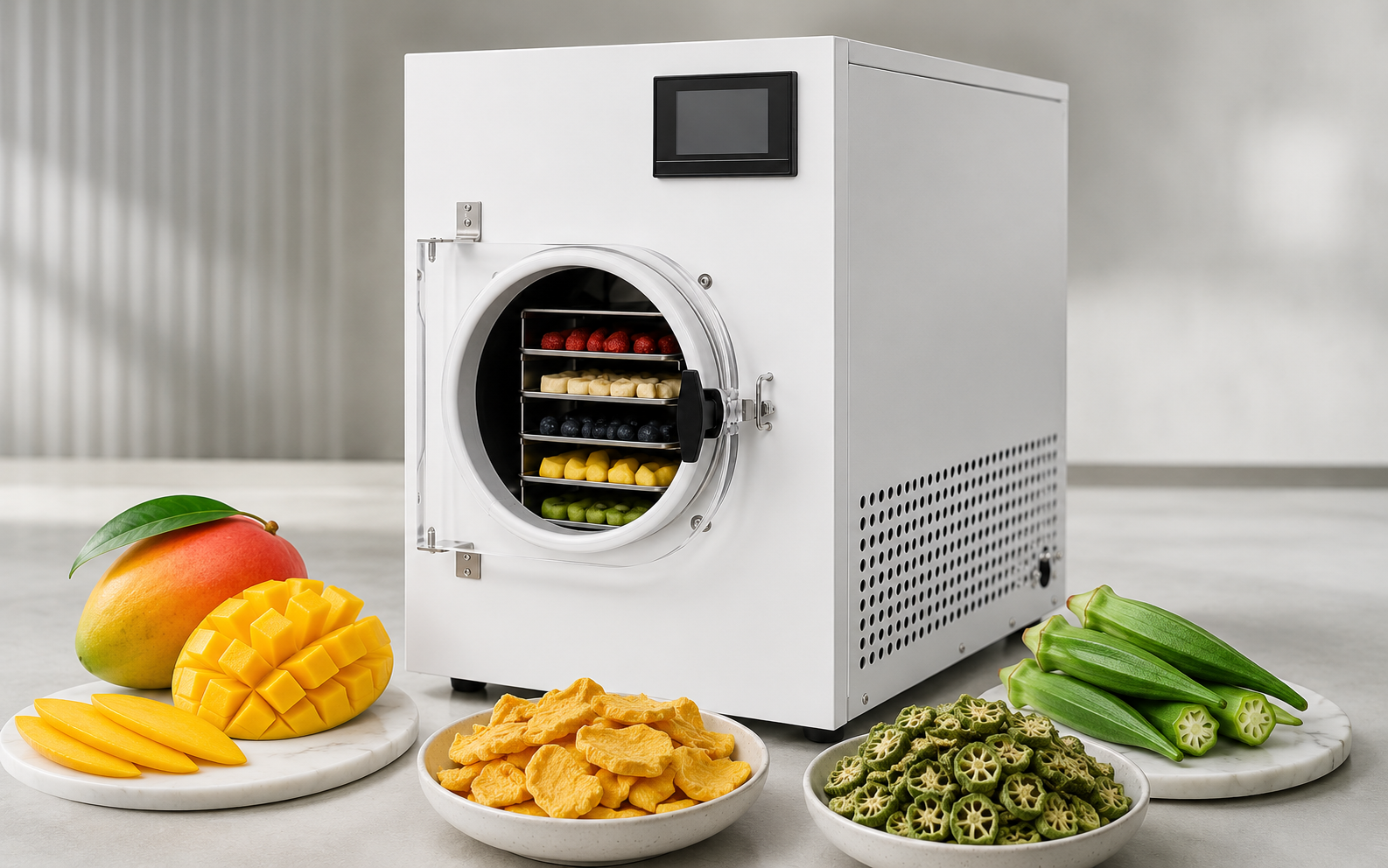
In fruit and vegetable freeze drying, mango and okra are two very different materials.
Mango is a high-sugar, juicy tropical fruit with strong aroma and bright color. Okra, on the other hand, is a health-oriented vegetable rich in mucilage, pectin, and polysaccharides. One is soft, sweet, and easy to oxidize; the other is fibrous, sticky, and sensitive to shape damage.
So, how can the same fruit and vegetable freeze drying equipment handle such different materials?
The answer lies in understanding the raw material, designing the right pretreatment process, and setting a suitable freeze drying curve. In this article, BOTH will explain the key processing ideas from material characteristics to parameter control.
1. Understand the Material Before Setting the Parameters
The first step in freeze drying is not turning on the machine. It is understanding the material.
For mango, the eutectic point is about -16.59°C, and the melting point is about -4.61°C. This means mango needs to be frozen below -16.59°C to achieve complete freezing. During the later heating stage, the material temperature must not exceed -4.61°C too early; otherwise, the frozen ice crystals may melt, causing product collapse, deformation, or surface shrinkage.
Okra is different.
Fresh okra pods have high moisture content and strong respiration, so they are not easy to store after harvest. The usual pre-freezing temperature for okra is between -55°C and -30°C, with a freezing time of about 2 to 4 hours. Because okra contains a large amount of mucilage composed of pectin and polysaccharides, it can form a relatively uniform ice crystal structure during freezing.
This is why different fruits and vegetables require different freeze drying parameters. A good freeze drying process always starts with the material’s freezing characteristics, moisture content, sugar content, fiber structure, and final product requirements.
2. Pretreatment: Mango Needs Color Protection, Okra Needs Anti-Sticking Control
Pretreatment directly affects the color, shape, taste, and final quality of freeze-dried fruits and vegetables.
Mango slices are easy to oxidize and turn brown after cutting, so the key pretreatment goal is color protection. A suitable process is blanching in boiling water at around 95°C for about 45 seconds. Another option is soaking the mango slices in a compound color-protection solution containing 0.015% ascorbic acid and 0.01% malic acid for 10 to 15 minutes.
For mango freeze drying, the recommended slice thickness is about 3 mm. This thickness helps balance drying speed, product appearance, texture, and rehydration performance.
Okra pretreatment focuses more on enzyme inactivation, color protection, and shape retention.
A recommended process is blanching okra in 100°C water for about 70 seconds, followed by soaking in a color-protection solution containing 1% sodium chloride, 1% sucrose, and 0.1% calcium chloride. After blanching, the okra should be cooled quickly to 2°C to 5°C to better maintain its fresh green color.
For okra freeze drying, the recommended slice thickness is usually 1 to 2 cm. It should not be too thin, because overly thin okra slices may become fragile and break easily after freeze drying.
3. Freeze Drying Curves: Slow Heating for Mango, Step-by-Step Heating for Okra
The freeze drying curve is one of the most important differences between beginner-level processing and professional freeze drying.
For mango, the freeze drying curve should be slow and stable.
A typical process includes 3 hours of pre-freezing, primary drying at around -5°C, and secondary drying at about 30°C. During the sublimation stage, the heating process should be gradual. This helps prevent the sugar on the mango surface from drying too quickly and forming a hard shell, which would block the sublimation path of internal moisture.
The vacuum level is usually controlled between 20 and 70 Pa, and the total drying time is generally 8 to 18 hours, depending on slice thickness, loading amount, moisture content, and equipment performance.
For okra, a step-by-step temperature curve is more suitable.
For example, one mature process is pre-freezing at -40°C for 3 hours, followed by staged freeze drying: holding at -25°C for 4 hours, -5°C for 6 hours, 5°C for 6 hours, and finally 25°C for 4 hours. The vacuum requirement can be higher, reaching around 1 Pa.
This gradient heating method allows the internal moisture of okra to sublimate in an orderly way from the outside to the inside. The final product can maintain a crisp texture, full shape, and attractive green appearance.
4. Two Key Points for Selecting Fruit and Vegetable Freeze Drying Equipment
When choosing fruit and vegetable freeze drying equipment, two factors are especially important.
First, the equipment should have flexible and accurate temperature control.
Mango requires precise control from around -5°C to 30°C during the drying process. Okra requires a wider gradient from about -40°C to 25°C. If a freeze dryer can only set a single fixed temperature, it will be difficult to handle different fruits and vegetables with stable results.
For commercial production, it is better to choose a freeze dryer with programmable temperature control, multi-stage recipe storage, real-time process monitoring, and stable shelf temperature control.
Second, pay attention to the cold trap’s ice capture capacity.
Mango has high moisture content, usually around 80% to 85%. Okra also contains a large amount of water. During drying, this moisture turns into vapor and must be captured by the cold trap in time. If the cold trap capacity is insufficient, the vacuum level may fluctuate, which can affect drying speed, color, shape, and final product quality.
Therefore, the cold trap capacity should match the batch processing volume. For example, small-batch testing can use a laboratory or small commercial freeze dryer, while larger daily output requires pilot-scale or industrial freeze drying equipment with stronger water capture capacity and more stable vacuum performance.
5. From Lab Testing to Industrial Production
A fruit and vegetable freeze dryer is not “universal” because one machine can process every material with the same setting. Its real value lies in flexible process control.
For new product development, the recommended path is:
Lab test → pilot production → commercial batch production → industrial freeze drying production line
In the lab stage, users can test slice thickness, pretreatment method, freezing temperature, drying curve, color, texture, flavor, and rehydration performance.
In the pilot stage, the process can be verified with larger loading quantities and more realistic production conditions.
In commercial and industrial production, the focus shifts to batch consistency, energy efficiency, capacity, hygiene design, data recording, and long-term operation stability.
This scale-up path helps reduce investment risk and supports producers as they expand from product testing to stable market supply.
6. Wider Applications Beyond Mango and Okra
The same freeze drying principles can be applied to many other fruits and vegetables, including strawberries, blueberries, apples, bananas, durian, dragon fruit, carrots, corn, mushrooms, broccoli, onions, spinach, and peppers.
Freeze drying is also widely used for high-value food products such as fruit powder, vegetable powder, instant soup ingredients, ready-to-eat meals, herbal powder, pet snacks, probiotic powder, nutrition powder, and functional food ingredients.
For some projects, freeze drying can also be combined with other processing technologies. For example, freeze drying can be used to make stable fruit, vegetable, or herbal powders, while molecular distillation can be used for purification and concentration of heat-sensitive oils, plant extracts, fish oil, vitamin E, MCT, and other high-value active ingredients.
This combined solution is especially suitable for food, herbal, nutrition, health supplement, and pharmaceutical-related projects.
Conclusion
From mango to okra, the secret of fruit and vegetable freeze drying is not using one fixed process for all materials. The real key is understanding each material and adjusting the process accordingly.
For mango, the focus is oxidation prevention, proper slice thickness, slow heating, and collapse control. For okra, the focus is blanching, color protection, shape retention, anti-sticking control, and staged temperature rise.
By understanding the eutectic point, designing targeted pretreatment, and setting a reasonable freeze drying curve, both the sweet flavor of mango and the fresh green quality of okra can be well preserved in one professional freeze drying system.
BOTH Instrument & Industrial Equipment (Shanghai) Co., Ltd. provides a full range of vacuum freeze drying equipment, including household freeze dryers, commercial freeze dryers, laboratory freeze dryers, pilot-scale freeze dryers, production-scale freeze dryers, and customized freeze-dried production line solutions.
Our freeze drying equipment can be used for fruits, vegetables, meat, seafood, instant meals, probiotics, nutrition powders, herbal products, pet food, biopharmaceutical materials, and biological research. We can also provide material testing, process support, equipment selection, OEM/ODM customization, and turnkey solutions for customers who plan to scale up from lab testing to industrial production.
What is your current production scale? Are you planning to expand? What capacity do you need per batch or per day?
Talk to BOTH engineers today to get a customized freeze drying solution for your material, process, and production goal.
Post time: Jul-20-2026