

1. Introduction
In recent years, the global Omega-3 industry has undergone a significant transformation driven by rising demand for sustainable and plant-based nutrition. Algae-derived Omega-3 oil has rapidly emerged as a preferred alternative to traditional fish oil due to its purity, environmental sustainability, and consistent quality.
Unlike marine-derived sources, algae Omega-3 is produced directly from microalgae cultivated under controlled industrial conditions. This makes it possible to achieve stable DHA and EPA yields while eliminating contamination risks commonly associated with ocean-based raw materials.
For manufacturers entering this sector, understanding the full industrial production process is essential for building a reliable and scalable production line.
2. Industrial Production Principle
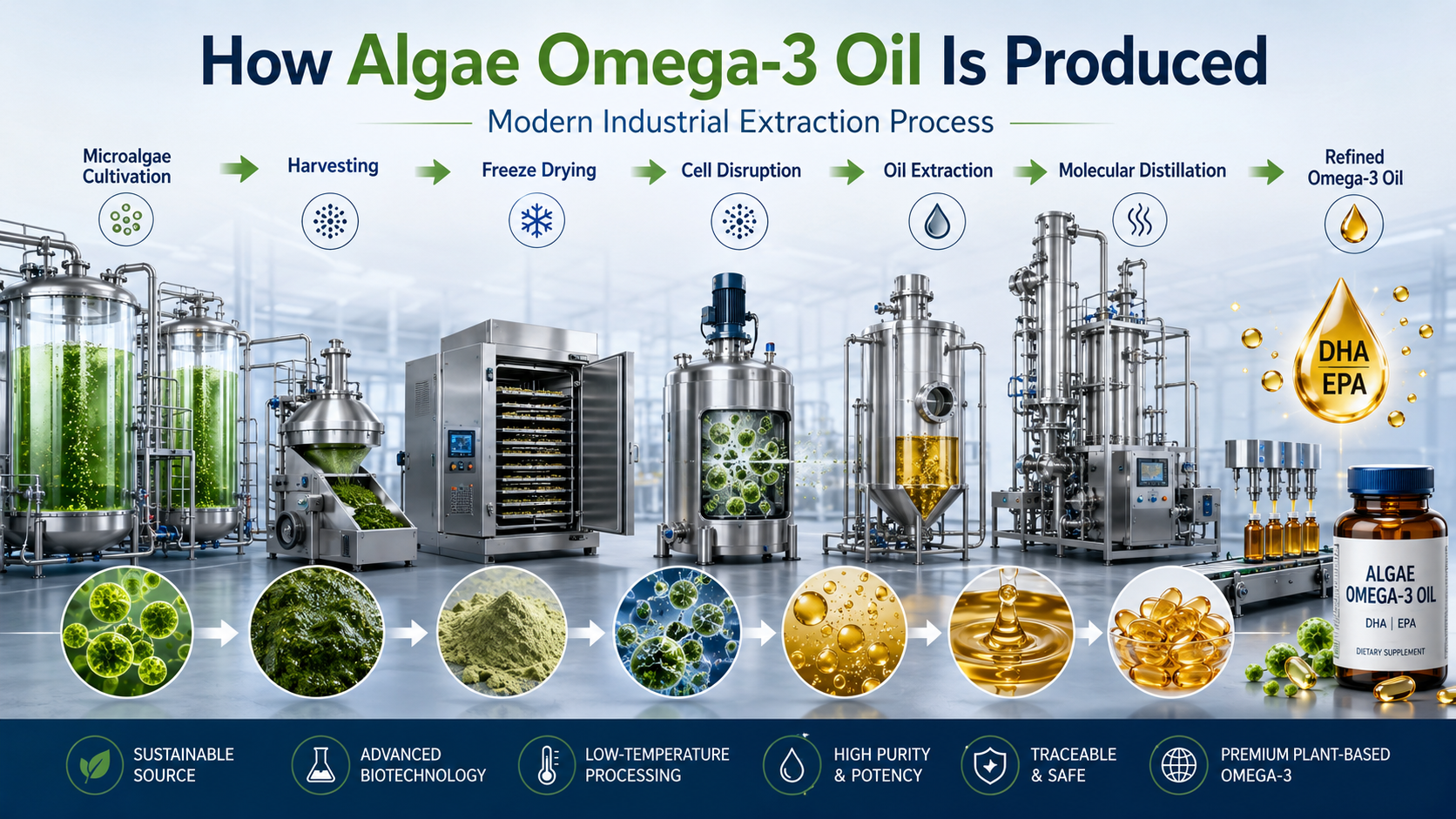
Algae Omega-3 production is based on a complete bioengineering and separation process that transforms microalgae biomass into highly purified DHA and EPA oil.
The production chain integrates biological cultivation, mechanical separation, low-temperature drying, lipid extraction, and high-vacuum purification. Each stage is designed to protect the heat-sensitive nature of Omega-3 fatty acids while maximizing yield and purity.
Key microalgae strains used in industrial production include Schizochytrium species for DHA-rich oil, Crypthecodinium cohnii for high-purity DHA production, and Nannochloropsis species for EPA-focused applications.
3. Industrial Applications and Market Demand
Algae Omega-3 oil is widely used in nutraceuticals, functional foods, infant formula, pharmaceutical supplements, and high-end health products.
The market demand is particularly strong in vegan nutrition and clean-label products, where algae-based Omega-3 provides a stable and traceable alternative to fish oil. As regulatory requirements for contaminants become stricter, manufacturers are increasingly shifting toward algae-derived production systems.
4. Industrial Scale Production Workflow
Modern algae Omega-3 manufacturing is a continuous industrial process that begins with large-scale microalgae cultivation in fermentation systems designed to maximize lipid accumulation.
After cultivation, biomass is separated from the culture medium and processed through controlled drying systems to reduce moisture content while preserving bioactivity. Cell disruption technology is then applied to release intracellular oils, followed by extraction using solvent-based or supercritical CO₂ systems.
The crude oil obtained from extraction undergoes a series of refining processes including degumming, neutralization, bleaching, and deodorization to improve stability and sensory quality. Finally, high-vacuum molecular distillation is applied to concentrate DHA and EPA fractions while removing unwanted impurities under low temperature conditions.
The entire production process is supported by storage and buffering systems, automated filling and packaging lines, clean-in-place sanitation systems, and centralized PLC automation control to ensure continuous and stable industrial operation.
5. Small Scale vs Industrial Scale Production
At laboratory and pilot scale, algae Omega-3 production focuses on process development, strain optimization, and small batch testing. These systems typically emphasize flexibility and experimental control, allowing manufacturers to refine extraction and purification parameters before scaling up.
At industrial scale, the focus shifts toward continuous production, efficiency, and cost optimization. Large-scale facilities integrate fully automated systems capable of handling high throughput biomass processing, solvent recovery, and molecular distillation under stable operating conditions. This transition from pilot to industrial scale is critical for commercial competitiveness in the Omega-3 market.
6. Complete Equipment Solution for Algae Omega-3 Production
A fully integrated algae Omega-3 production plant requires multiple interconnected processing systems designed for continuous operation and high efficiency.
The production line typically includes fermentation and cultivation systems for microalgae growth, harvesting and separation equipment for biomass collection, and low-temperature drying systems for moisture control. Cell disruption technology is used to break down algae cell walls, enabling efficient oil release during extraction.
Oil extraction systems are followed by solvent recovery and purification units, ensuring safe and efficient separation of lipids. Molecular distillation systems operate under high vacuum conditions to refine and concentrate DHA and EPA fractions with high purity and thermal protection.
Supporting systems such as storage tanks, intermediate buffer vessels, automated filling and packaging lines, CIP cleaning systems, and PLC-based control platforms ensure smooth integration of the entire production workflow.
7. Frequently Asked Questions
Algae Omega-3 is often compared with fish oil in terms of nutritional value, but its main advantage lies in its sustainability and absence of marine contaminants. It is widely accepted in vegan and infant nutrition markets due to its plant-based origin.
Molecular distillation is a critical step in Omega-3 production because DHA and EPA are highly sensitive to heat and oxidation. High-vacuum conditions allow separation at lower temperatures, preserving product quality while achieving high purity levels.
Freeze drying is commonly used in algae processing because it minimizes thermal degradation and helps preserve bioactive compounds before extraction, especially in high-value nutraceutical applications.
For new manufacturers, pilot-scale systems are recommended for process validation, while commercial production plants typically start from medium to large capacity depending on target market demand and investment scale.
8. Conclusion and Turnkey Solution
As the global demand for algae-based Omega-3 continues to grow, manufacturers are increasingly focusing on fully integrated and scalable production systems that ensure consistent product quality and operational efficiency.
BOTH provides complete turnkey solutions for algae Omega-3 production plants, covering core equipment such as freeze dryers, molecular distillation systems, extraction units, and automated control platforms. With extensive engineering experience in separation and purification technology, we support customers from laboratory development to full-scale industrial production.
For companies planning to enter the Omega-3 market or upgrade existing facilities, a well-designed turnkey system significantly reduces engineering risk and accelerates time to market while ensuring long-term production stability.
Post time: Jun-25-2026