

In today’s highly competitive food industry, continuous product innovation is essential for survival and growth. Large-scale production freeze dryers are no longer just back-end processing equipment. They are becoming a powerful tool for food factories to create innovative and high-value products.
A large freeze dryer is not simply a drying machine. It is a technology platform that can help transform ordinary ingredients into premium products with better nutrition, longer shelf life, unique texture, and stronger market appeal.
So how can food factories use this equipment to develop impressive new products?
1. Understand the Advantages of Freeze Drying Technology
Before developing new products, food factories should first understand what freeze drying can bring to product innovation.
Compared with traditional hot-air drying or frying, freeze drying offers several key advantages.
Preserves Color, Aroma, Flavor, and Shape
Freeze drying removes moisture under low temperature and vacuum conditions. This helps preserve the original color, flavor, aroma, shape, and nutritional value of the ingredients.
For fruits, vegetables, meat, dairy products, and functional ingredients, this advantage is especially important.
Creates a Unique Crispy Texture
Freeze-dried products have a porous internal structure. This creates a light, crispy, melt-in-the-mouth texture that is difficult to achieve with other drying methods.
This special texture is one of the main reasons why freeze-dried snacks are popular in the premium food market.
Excellent Rehydration Performance
Freeze-dried products can quickly absorb water and return close to their original fresh state. This makes freeze drying highly suitable for instant food, soup ingredients, porridge, meal kits, camping food, and emergency rations.
Longer Shelf Life Without Preservatives
Because freeze drying greatly reduces moisture content and water activity, it can effectively inhibit microbial growth. This helps extend product shelf life without relying heavily on preservatives.
For consumers looking for clean-label, healthy, and convenient food, this is a strong selling point.
2. New Product Development Directions for Food Factories
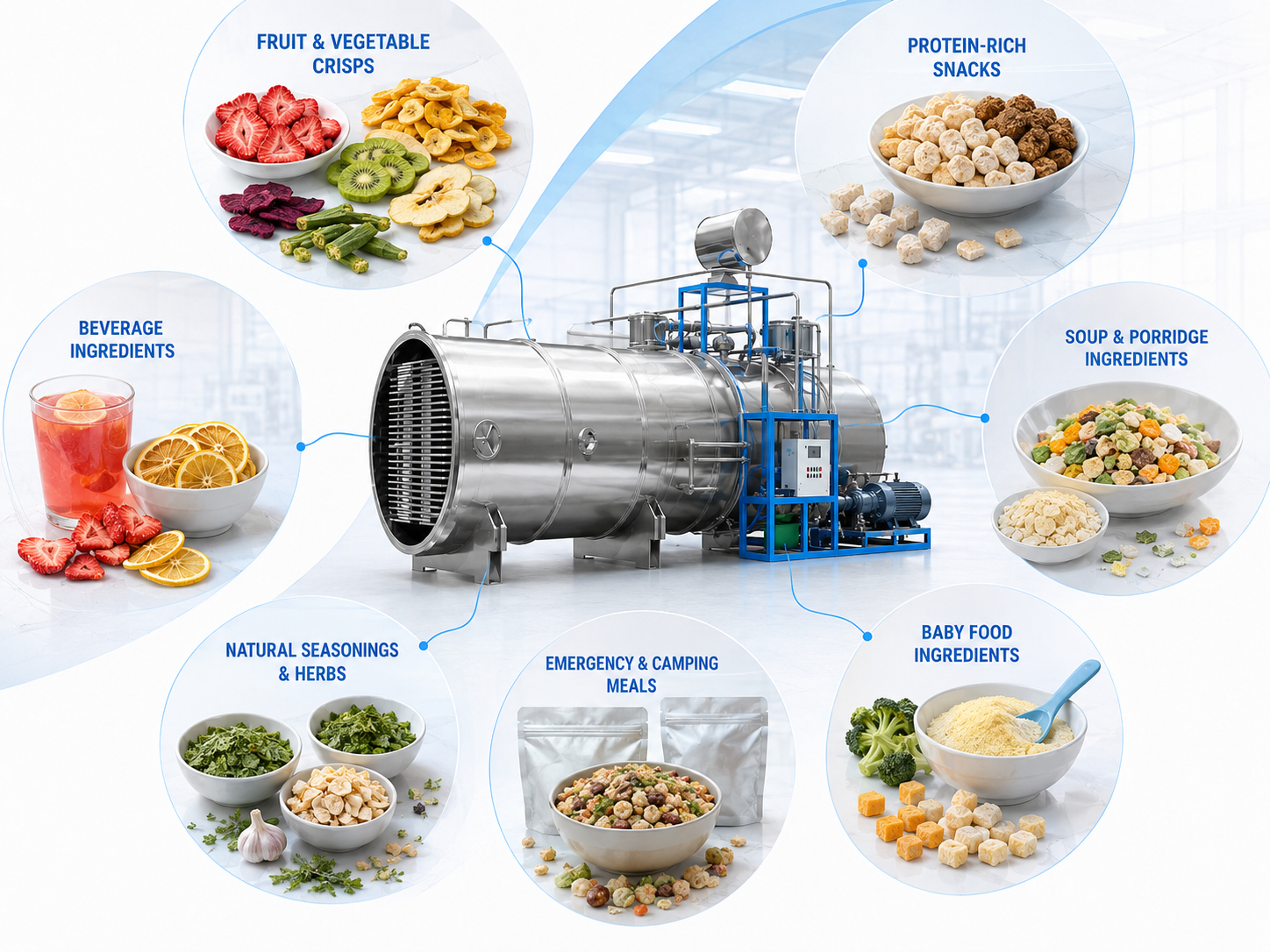
Based on the advantages of freeze drying, food factories can develop new products in several promising directions.
Healthy Snack Series
Freeze-Dried Fruit Pieces
Factories do not need to limit themselves to common products such as freeze-dried strawberries and mangoes. They can also develop mixed berry snacks, freeze-dried fruit corn, tropical fruit cubes, or “fruit + yogurt” filled freeze-dried bites.
These products can target children, office workers, fitness consumers, and health-conscious snack buyers.
Freeze-Dried Vegetable Crisps
Low-salt, non-fried vegetable crisps are becoming more popular as consumers pay more attention to healthy eating. Okra crisps, mushroom crisps, sweet pepper crisps, broccoli crisps, and carrot crisps are all potential product directions.
Compared with fried snacks, freeze-dried vegetable crisps can offer a cleaner ingredient list and stronger nutritional appeal.
Freeze-Dried Protein Snacks
Food factories can also freeze dry yogurt, cheese, chickpea puree, bean products, or other protein-rich materials to create high-protein snack products.
This category is suitable for sports nutrition, children’s snacks, weight management, and functional food markets.
Convenient Meals and Food Ingredients
Instant Soup and Porridge Ingredients
Freeze drying allows real meat pieces, vegetables, grains, seafood, and seasoning ingredients to be preserved in a lightweight and shelf-stable form.
After adding hot water, consumers can enjoy a more complete and satisfying instant soup or porridge with real ingredients.
Baby Food
Freeze drying can be used to produce fruit and vegetable powders, meat floss, nutrition porridge cubes, and other baby food ingredients.
Because the process helps preserve nutrition and avoids unnecessary additives, it is suitable for high-quality infant and toddler food development.
Camping Food and Military Rations
Freeze-dried meals are lightweight, easy to carry, long-lasting, and nutritionally balanced. They are ideal for camping, hiking, outdoor travel, emergency food, and military ration applications.
This is a growing market with strong demand for convenience and reliable nutrition.
Functional Food
Natural Seasonings
Freeze-dried scallions, coriander, garlic granules, ginger, chili, and herbs often have stronger natural aroma than hot-air-dried products.
They can be used in instant noodles, soup bases, sauces, ready meals, and premium seasoning packs.
Beverage Innovation
Freeze-dried fruit slices such as lemon, orange, strawberry, and pineapple can be used in tea drinks, fruit infusions, cocktails, and premium beverage decorations.
Freeze-dried herbs and flowers such as mint, osmanthus, rose, and chrysanthemum can also add natural flavor and visual appeal to high-end drinks.
3. A Scientific Process for New Product Development
A good idea is only the starting point. To successfully launch a freeze-dried food product, factories need a scientific development process.
Step 1: Raw Material Selection and Pretreatment
Not every ingredient is suitable for freeze drying. Food factories need to test different varieties, maturity levels, cutting methods, pretreatment processes, and loading thicknesses.
For example, fruit sweetness, fiber structure, water content, acidity, and oxidation sensitivity can all affect the final appearance, texture, flavor, and drying efficiency.
Pretreatment methods such as washing, slicing, blanching, color protection, sugar adjustment, seasoning, or pre-freezing should be optimized according to the material.
Step 2: Process Parameter Development
This is the core stage of freeze-dried product development.
The factory needs to work closely with equipment engineers and operators to find the best parameters for each product, including pre-freezing temperature, shelf temperature, vacuum level, drying time, heating curve, and final moisture target.
These parameters directly determine product texture, appearance, rehydration performance, production efficiency, and cost.
For example, high-sugar fruits may require slower heating to prevent collapse or surface hardening. Vegetables may need staged temperature control to maintain color and shape. Protein-rich materials may require careful temperature management to protect structure and taste.
Step 3: Packaging Design and Testing
Freeze-dried products are highly sensitive to moisture. Once they absorb water from the air, they may lose crispness, clump together, or experience quality deterioration.
Therefore, packaging is a critical part of product development.
Factories should test different packaging materials for moisture resistance, light protection, oxygen barrier performance, sealing strength, and shelf-life stability.
Common solutions include aluminum foil bags, high-barrier composite films, desiccants, oxygen absorbers, and nitrogen flushing, depending on the product type and sales channel.
Step 4: Market Testing and Feedback
Before mass production, it is recommended to run small-batch trial production and test the products with target consumers.
Feedback should focus on flavor, texture, appearance, portion size, packaging, price acceptance, and purchase intention.
Based on market feedback, the factory can adjust the formula, drying process, packaging format, and product positioning before launching full-scale production.
This helps reduce risk and improve the success rate of new products.
4. Cost and Benefit Considerations
Using large freeze dryers for new product development also requires a realistic understanding of investment and operating costs.
Equipment Investment and Energy Consumption
Large-scale freeze dryers require higher upfront investment. The freeze drying process also consumes energy because it involves refrigeration, vacuum, heating, and long drying cycles.
Therefore, factories should evaluate not only the machine price but also long-term energy consumption, production efficiency, maintenance cost, and labor cost.
Product Positioning and Pricing Strategy
Because freeze-dried products usually have higher production costs, they are often positioned in the mid-to-high-end market.
Factories should highlight product value through clear selling points such as “technology-preserved freshness,” “nutrition retention,” “non-fried,” “no preservatives,” “lightweight,” “long shelf life,” and “real ingredients.”
A strong product story can help support a higher retail price.
Production Efficiency and Batch Planning
To reduce unit production cost, factories should plan production batches carefully and use the freeze dryer at full loading capacity whenever possible.
Efficient scheduling, proper loading thickness, optimized drying curves, and stable process control can all help improve output and reduce cost per batch.
Conclusion
For food factories, a large freeze dryer is no longer just a production tool. It is a bridge between market demand and technology innovation.
By understanding the advantages of freeze drying, exploring new application directions, and following a scientific development process, food factories can create a wide range of products with unique selling points and strong market competitiveness.
From healthy snacks and instant meals to baby food, functional ingredients, camping food, natural seasonings, and premium beverage ingredients, freeze drying opens the door to many high-value product opportunities.
BOTH can help customers select suitable freeze drying equipment according to material type, batch capacity, moisture content, product form, and future expansion plan. We provide laboratory, pilot-scale, commercial, and industrial freeze dryers, as well as material testing, process support, OEM/ODM customization, and turnkey freeze-dried production line solutions.
What is your current production scale? Are you planning to expand? What capacity do you need per batch or per day?
Talk to BOTH engineers to get a customized freeze drying solution for your new product development and factory production plan.
Post time: Jul-21-2026