

Fruit and vegetable vacuum freeze drying technology is gaining popularity because it can preserve food nutrition, color, flavor, and structure to the greatest extent. From home-made healthy snacks to large-scale food production, choosing the right freeze dryer is the first step toward success.
In this article, BOTH will explain the core differences between home, commercial, and industrial fruit and vegetable vacuum freeze dryers, and provide practical buying tips to help you choose the most suitable equipment.
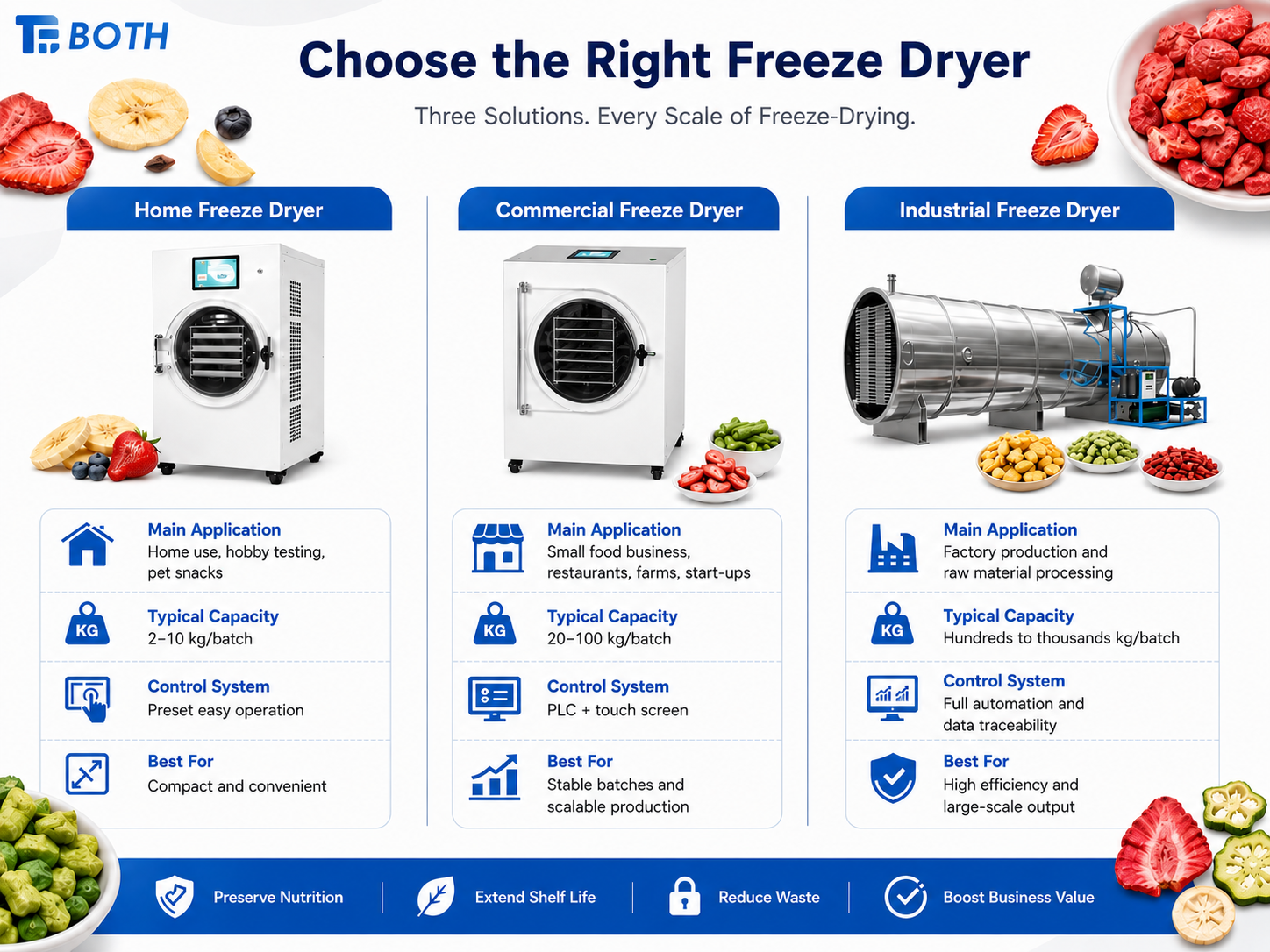
1. Core Differences: From Kitchen Use to Factory Production
Although the basic principle is the same—removing moisture through low-temperature pre-freezing and vacuum sublimation—freeze dryers designed for different application scenarios vary greatly in capacity, control system, structure, and production stability.
| Comparison Item | Home Fruit & Vegetable Freeze Dryer | Commercial Fruit & Vegetable Freeze Dryer | Industrial Fruit & Vegetable Freeze Dryer |
| Main Application | Home use, hobby testing, pet snack making | Small-scale commercial production, start-up brands, restaurants, farms | Large-scale industrial production and raw material processing |
| Typical Capacity | 2–10 kg fresh material per batch, freeze drying area usually ≤0.5 m² | 20–100 kg fresh material per batch, freeze drying area around 1–5 m² | Hundreds to thousands of kilograms per batch, freeze drying area usually ≥5 m² |
| Key Performance | Meets basic freeze drying needs; temperature and vacuum control may fluctuate | Stable performance, accurate temperature and vacuum control, better batch consistency | High efficiency, low energy consumption, advanced systems such as heat recovery |
| Control & Operation | Preset programs, simple button operation, easy to use | PLC + touch screen control, supports complex recipe setting and storage | Fully automatic central control, remote monitoring, data traceability, production management compatibility |
2. Deeper Differences in Process, Safety, and Design
Home freeze dryers usually rely on general preset programs. They are suitable for personal use, simple testing, and small household production.
For commercial and industrial production, each product often requires a customized freeze drying process. Different fruits and vegetables have different moisture content, sugar content, acidity, fiber structure, and heat sensitivity. Therefore, the drying curve should be designed according to the material.
Food manufacturers also need to consider food safety management, such as HACCP planning, sanitation control, batch records, and production traceability.
In terms of equipment design, commercial and industrial freeze dryers usually have higher standards. For example, they may use food-grade stainless steel or corrosion-resistant materials, rounded inner corners for easier cleaning, CIP cleaning support, and designs that meet food or pharmaceutical production requirements.
These details are not only about appearance. They directly affect hygiene, safety, durability, maintenance convenience, and long-term production reliability.
3. Buying Tip 1: Clarify Your Real Production Needs First
Before comparing technical parameters, you should first define your real application.
What is the main purpose of the equipment? Is it for home DIY, small-batch sales, or building a production line?
What fruits and vegetables will you process? Different materials require different equipment performance. For example, high-sugar mango or high-acid berries require good anti-sticking design and corrosion-resistant materials. Heat-sensitive materials such as kiwi require stable vacuum performance and full-process low-temperature drying.
What is your expected daily or annual output? This directly determines the freeze drying area and cold trap capacity you need.
What is your available space and budget? Commercial and industrial freeze dryers may require higher power supply capacity, enough installation space, and supporting production conditions. Large industrial systems may also require clean workshops and auxiliary equipment.
Only after these questions are clear can you choose the right freeze dryer model.
4. Buying Tip 2: Evaluate the Core Technical Parameters
After defining the application range, the following technical parameters should be carefully checked.
Freeze Drying Area
Freeze drying area is the most direct factor affecting batch capacity. It can be estimated according to the material loading thickness, tray size, moisture content, and target processing volume.
For example, sliced fruits are often loaded in a thin layer, while larger vegetable pieces may require more tray spacing. If the freeze drying area is too small, production efficiency will be limited.
Cold Trap Temperature and Ice Capture Capacity
The cold trap captures water vapor released during sublimation. Its temperature should be lower than the eutectic point of the material. For many fruit and vegetable applications, cold trap temperatures of -40°C to -50°C or lower are required.
A lower cold trap temperature, such as -60°C, can improve ice capture efficiency and drying speed. Ice capture capacity determines how much water the equipment can remove in one cycle, which directly affects batch size and continuous operation ability.
Vacuum Level
A good vacuum level is essential for stable sublimation. For fruit and vegetable freeze drying, the ultimate vacuum is usually required to be ≤10 Pa, depending on the process and material.
A low vacuum leakage rate is also important. If the vacuum is unstable, the drying process may slow down, and the product may shrink, collapse, discolor, or lose quality.
Temperature Control Range and Accuracy
The shelves should support both cooling and heating. For commercial and industrial freeze dryers, a wide temperature range is important, such as shelf cooling below -50°C and heating above +60°C.
Temperature uniformity is also critical. In high-quality production, shelf temperature difference should be controlled within a small range to ensure consistent product quality across different trays and batches.
5. Buying Tip 3: Check the Equipment Structure and Control System
Freeze dryers are available in different structures. Common types include bell-jar freeze dryers and in-situ freeze dryers.
Bell-jar freeze dryers are simple in structure and lower in cost, but they often require more manual operation. In-situ freeze dryers complete pre-freezing and drying in the same chamber, offering higher automation and better process stability. This structure is now widely used in commercial and industrial production, especially when users need process development and batch consistency.
The control system is another key difference.
For commercial and industrial use, PLC touch screen control is highly recommended. It allows users to set multi-stage freeze drying curves, control temperature and vacuum more accurately, store recipes, record data, and trace production history.
This is essential for standardized production, quality control, and future scale-up.
6. Buying Tip 4: Consider After-Sales Service and Long-Term Cost
The purchase price is only part of the total investment. Long-term operating cost is equally important.
Before purchasing, confirm the warranty period, technical support capability, spare parts supply, and the cost of wearing parts such as vacuum pump oil, sealing rings, filters, and sensors.
You should also estimate power consumption, regular maintenance cost, labor cost, and possible downtime loss.
Energy-saving designs such as efficient refrigeration systems, variable-frequency compressors, optimized vacuum systems, and heat recovery can reduce long-term production cost. For commercial and industrial users, these savings may be more important than the initial price difference.
7. How to Choose the Right Level of Freeze Dryer
For home users, safety, convenience, compact size, and easy operation should be the top priorities.
For start-up brands and small or medium-sized businesses, the key is process controllability and batch stability. A commercial freeze dryer with programmable control, good cold trap capacity, and stable vacuum performance can help maintain product quality and support market growth.
For large production enterprises, the decision should be based on capacity, energy efficiency, automation level, cleaning design, compliance requirements, and full life-cycle cost. Industrial freeze drying equipment is not only a machine purchase, but also a strategic investment in production capability.
A practical scale-up path is:
Lab testing → small commercial production → pilot production → industrial freeze drying production line
This path helps reduce investment risk and allows users to optimize product formulas, drying curves, packaging methods, and production standards step by step.
Conclusion
Choosing a fruit and vegetable vacuum freeze dryer is essentially about finding the best balance between equipment performance and real production needs.
Home users should focus on safety and ease of use. Start-ups and small businesses should focus on stable process control and batch consistency. Large factories should evaluate capacity, energy efficiency, automation, hygiene design, and compliance from a long-term production perspective.
Before making a final decision, it is always recommended to ask the supplier for sample freeze drying tests. Seeing the actual drying result of your own material is one of the most effective ways to avoid purchasing mistakes.
BOTH provides a full range of vacuum freeze drying equipment, including home freeze dryers, commercial freeze dryers, laboratory freeze dryers, pilot-scale freeze dryers, industrial freeze dryers, and customized freeze-dried production line solutions. We can also support material testing, equipment selection, process optimization, OEM/ODM customization, and turnkey project planning for fruit, vegetable, food, nutrition, herbal, biological, and pharmaceutical applications.
What is your current production scale? Are you planning to expand? What capacity do you need per batch or per day?
Talk to BOTH engineers to get a customized freeze drying solution for your material and production goal.
Post time: Jul-21-2026