

A Freeze Dryer (lyophilizer) uses the principle of sublimation to dry materials. The process involves rapidly freezing the material at low temperatures, and then, under a suitable vacuum environment, allowing the frozen water molecules to sublime directly into water vapor and escape. The product obtained by freeze-drying is called a lyophilizate (or lyophilized product), and the process is known as lyophilization.
Before drying, the material remains at low temperatures (in a frozen state), with ice crystals uniformly distributed within it. During sublimation, no concentration occurs due to dehydration, thereby avoiding side effects such as foaming or oxidation caused by water vapor. The dried material takes on a dry, porous, sponge-like structure with virtually no change in volume, and it dissolves easily in water to restore its original state. This process largely prevents physicochemical and biological degradation of the material.
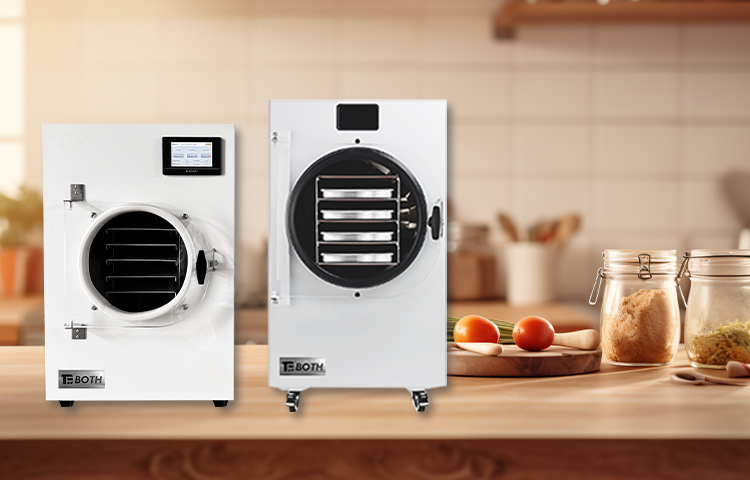
A freeze dryer consists of a refrigeration system, a vacuum system, a heating system, and an electrical instrument control system. Its main components include a drying chamber, a condenser (cold trap), a refrigeration unit, a vacuum pump, and heating/cooling devices. The working principle of the freeze dryer is to first freeze the material to be dried to a temperature below its triple point, then, under vacuum conditions, allow the solid water (ice) in the material to sublime directly into water vapor and be removed, thereby drying the material. After pre-treatment, the material is sent to a quick-freezing warehouse for freezing, then transferred to a drying warehouse for sublimation dehydration, and finally packaged in a post-processing workshop. The vacuum system creates a low-pressure environment for the sublimation drying chamber, the heating system supplies the latent heat of sublimation to the material, and the refrigeration system provides the required cooling capacity for the cold trap and drying chamber.
This equipment uses efficient radiation heating, ensuring uniform heat distribution on the material. It features an efficient water vapor capture cold trap with rapid defrosting capability, a high-performance vacuum unit with oil-water separation, and a parallel centralized refrigeration system that supplies cooling on demand through multiple circuits, resulting in stable operating conditions and energy savings. An artificial intelligence control system ensures high precision and convenient operation.
Quality requirements for freeze-dried products include: unchanged biological activity, uniform appearance and color, plump morphology, firm structure, fast dissolution, and low residual moisture. To obtain high-quality products, a comprehensive understanding of freeze-drying theory and processes is essential. The freeze-drying process consists of three stages: pre-freezing, sublimation, and secondary drying. Reasonably and effectively shortening the freeze-drying cycle has significant economic value in industrial production
Post time: Apr-08-2026